
WARDOGS Helicopter Guide
Answer
Helicopters are bought at the buy screen, and buying one makes you the pilot — there is no pilot class to unlock. BULKHEAD describes them as the lifeline of the battlefield: they ferry squads to the front line, run supply missions and extract a squad when a push collapses. Because transporting team-mates and running supplies are both paid actions, flying transport is one of the more reliable ways to earn on a 256 km² map. The main threat is player-built anti-air emplacements.
Why helicopters matter more here than in most shooters
The numbers do the arguing. A WARDOGS map is 16×16 km. The Control Zone is a 2×2 km square somewhere inside it, and points go to whichever team has the most players standing on that square.
So the question that decides matches is not who shoots better but who can keep bodies on the square. Every death starts a journey across terrain measured in kilometres. A helicopter turns that journey from minutes into seconds, for an entire squad at a time.
That makes the pilot role structurally important in a way that is easy to underrate:
- A transport pilot raises the whole team's zone headcount, continuously, without firing a shot.
- The work pays. Transport and supply runs are confirmed income, so flying is not a sacrifice role — it is a job.
- It combines with fortification. A helicopter plus a well-placed forward operating base largely solves a team's logistics problem for a match.
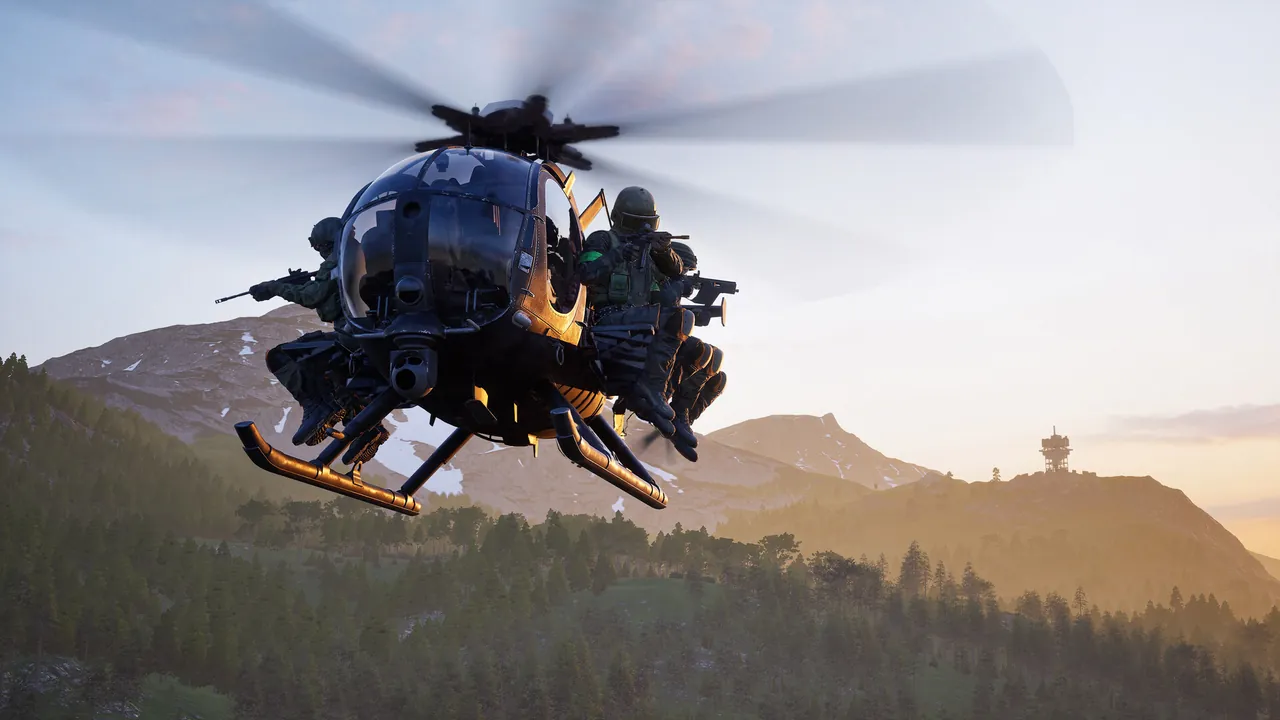
Helicopter types
| Type | Purpose | Notes |
|---|---|---|
| Transport helicopter | Squad insertion, supply runs, extraction | The confirmed core role. Highest income potential, lowest direct combat value |
| Light attack helicopter | Armed support with door gunners | Shown in official screenshots with side-mounted guns and crew. Combines transport with fire support |
Not published: individual airframe names, purchase prices, passenger capacity, fuel or damage models, flight control schemes and keybinds, and whether dedicated attack helicopters exist separately from armed transports. Fighter jets are a separate, later addition — see the vehicles database.
Flying: what is known
Official footage shows a full cockpit interior with working instrumentation rather than a simplified third-person flight model, and the HUD keeps the player's cash balance visible while flying. BULKHEAD has published a Level Design & Performance video that gives the clearest look at how the terrain reads from the air.
Two practical points that can be stated now:
- Controller support on PC is officially described as limited. If you were planning to fly on a gamepad, plan for mouse and keyboard instead until Team17 says otherwise. See troubleshooting if a controller is not registering at all.
- Proximity voice chat exists, so passengers and the pilot can coordinate directly without a squad system in between — which matters a lot for calling a landing zone that is not currently under fire.
Surviving as a pilot
The specific danger in WARDOGS is that air denial is built, not just bought. Any enemy player can construct an anti-air emplacement as part of the fortification system, which means the threat picture changes during a match as teams dig in around the zone.
- Fly the terrain, not the straight line The map is industrial mountains and valleys. Ridges and treelines break line of sight from emplacements that would otherwise track you the whole way in.
- Never approach the zone centre directly The Control Zone is where the fortifications are. Land short and let the squad cover the last stretch on foot.
- Assume the third team is watching A flight path that avoids one faction's anti-air may fly straight over the other's. This is the recurring lesson of a three-team game.
- Do not loiter A hovering helicopter is a stationary target worth a large amount of the enemy's money to destroy — and worth a large amount of yours to lose.
- Rebuy the cheap airframe, not the expensive one If anti-air is up, a cheaper transport that you can afford to lose twice beats an expensive one you can afford to lose once.
Shooting helicopters down
From the other side of the problem:
- Build anti-air emplacements near the zone — the purpose-built answer, and it covers the whole team rather than one player.
- Anti-armour weapons bought as infantry equipment can engage aircraft, particularly ones that loiter or land.
- Contest the landing zone. Killing the squad as it disembarks is often easier than killing the aircraft, and costs the enemy the same headcount.
Helicopter FAQ
How do you fly a helicopter in WARDOGS?
Buy one at the buy screen and you spawn into it as pilot. There is no pilot class or certification. Control mappings will be documented here from the Early Access build; controller support on PC is officially limited, so assume mouse and keyboard.
What are helicopters for in WARDOGS?
Ferrying squads to the front line, supply missions and rapid extraction. BULKHEAD calls them the lifeline of the battlefield.
Does flying a helicopter earn money?
Yes. Transporting team-mates and running supplies are both confirmed paid actions.
How do you shoot down a helicopter in WARDOGS?
With built anti-air emplacements, anti-armour weapons, or by killing the squad at the landing zone.
Are there attack helicopters in WARDOGS?
Official screenshots show light helicopters with door gunners. Whether dedicated attack airframes exist separately from armed transports has not been confirmed.
Can passengers shoot from a helicopter?
Door-gunner positions are visible in official screenshots. Full seat and weapon mechanics have not been documented.
Sources: the official Steam store page (helicopter logistics, paid transport and supply actions, proximity voice, limited controller support), BULKHEAD's game page, official screenshots and Team17's Level Design & Performance video. Flight tactics are this wiki's own analysis of published mechanics. Back to all vehicles.