
WARDOGS Factions
Answer
WARDOGS has three factions: LONESTAR, VALKYRA and MANTICORE. Each of the three teams in a 100-player match represents one of them. LONESTAR are Western paramilitary heavy-hitters; VALKYRA seek to restore the Soviet People's Republic; MANTICORE are the Kingdom of Persia's shadow army. All three are fighting over PV-1, a rare resource in the fictional Eastern European region of Kolchia. No faction-selection system has been announced, and nothing suggests the factions differ mechanically.
The three factions
LONESTAR
Western paramilitary heavy-hitters. The private-contractor side of the war — well-funded, professionalised, and in Kolchia because someone is paying. The name signals an American corporate-military identity rather than a national army.
VALKYRA
Seeking to restore the Soviet People's Republic. The faction most directly tied to Kolchia's own history — a restorationist force fighting for a state that no longer exists, on ground that used to belong to it.
MANTICORE
The Kingdom of Persia's shadow army. A state actor operating without acknowledging that it is one. The third power in a war that the other two might otherwise have treated as bilateral.
Kolchia and PV-1
The setting explains why three separate armies are standing in the same valley.
Kolchia is a fictional Eastern European region that BULKHEAD describes as war-torn industrial mountains. Beneath it is PV-1, a rare resource the studio says has fuelled decades of Eurasian conflict. The maps reflect this directly — container yards, rail infrastructure, mining and processing sites, and the settlements that grew around them, all now contested ground.
It is a tidy piece of worldbuilding for the mechanics it has to justify. A resource war explains a Western contractor force, a restorationist successor state and a deniable third power all arriving at once, which in turn justifies the three-team format that makes the game structurally different from its competitors.
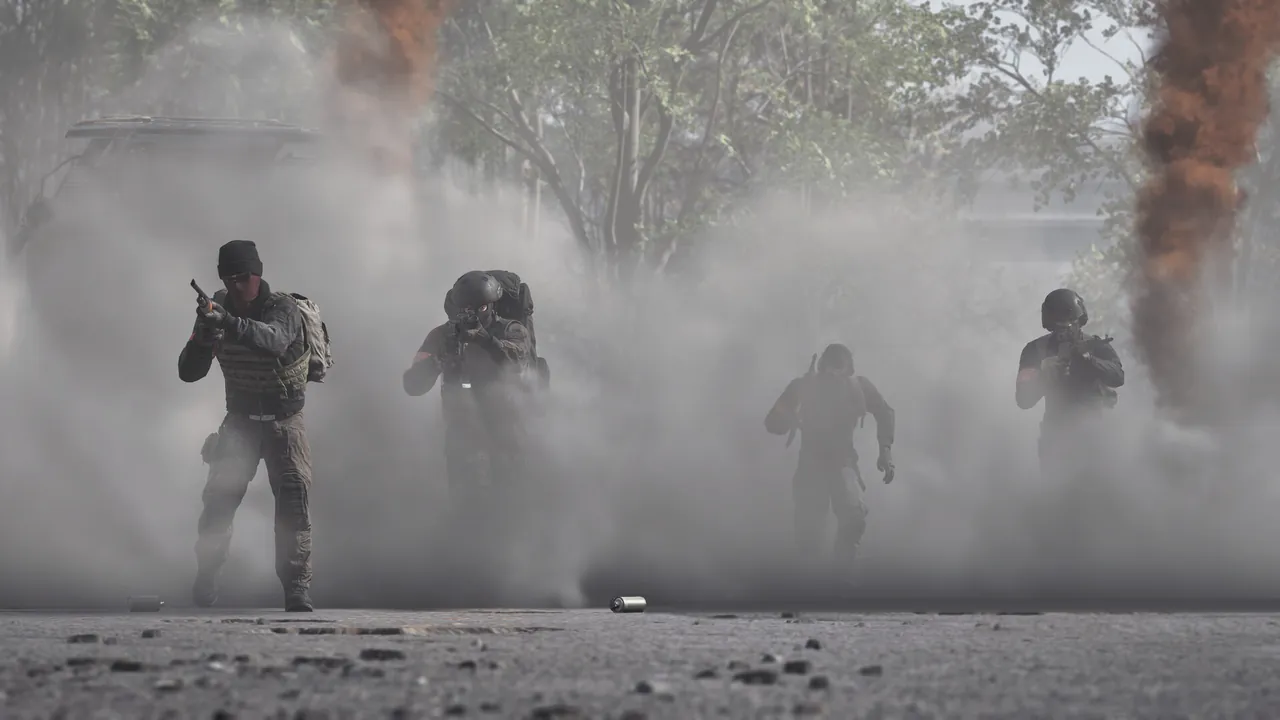
Can you choose your faction?
No faction-selection system has been described. Matchmaking places you on one of the three teams, and the HUD displays which faction currently controls the Control Zone — visible in official screenshots as a control indicator naming the holding faction.
This is consistent with the rest of the game's design. WARDOGS deliberately avoids things that partition players before a match starts: there are no classes to pick, no unlock progression, and no persistent loadout to build. Faction appears to work the same way — an identity assigned to the team you were placed on, not a choice that carries meaning between matches.
Do the factions play differently?
Nothing announced suggests they do. All three teams contest the same objective under the same scoring rules with the same $10,000 opening balance and the same buy screen. BULKHEAD has not described faction-specific weapons, vehicles, abilities or stat differences.
Treat any claim of a “best faction” in WARDOGS as unverified. If asymmetry is added or documented later, it will be described here with a source and a date.
What the factions do provide is visual and tactical legibility. On a battlefield with 100 players in three colours, being able to identify at a glance whether the people ahead of you are the faction you were already fighting or the third one — who may be about to solve your problem for you — is genuinely important information. In a two-team shooter, everyone not on your team is the same threat. Here they are not.
Why three factions changes the game
The faction count is not flavour; it is the central mechanical idea. Some consequences worth internalising:
- The leader gets attacked from two sides. If one faction pulls ahead on points, the other two are both incentivised to stop them. The format self-corrects against runaway leads.
- Committing fully is riskier. Every fight you take is watched by a third party who profits regardless of who wins.
- Disengaging can win. Letting the other two grind each other down while you bank zone ticks is a legitimate, and often correct, strategy.
- Temporary de facto truces happen. Not through any mechanic — simply because two factions frequently share an interest in stopping the third.
Detail on how this plays out in scoring is on the how to win page.
What is known about the story
WARDOGS has no single-player campaign and no narrative mode. The lore exists as setting rather than as story: Kolchia, PV-1, and three factions with mutually incompatible reasons for being there.
Not published: faction leadership or named characters, the timeline of the Kolchia conflict, what PV-1 actually is in-fiction, whether factions have distinct equipment aesthetics beyond colour identity, and whether more factions are planned during Early Access.
Factions FAQ
What are the three factions in WARDOGS?
LONESTAR (Western paramilitary), VALKYRA (restoring the Soviet People's Republic) and MANTICORE (the Kingdom of Persia's shadow army).
Can you choose your faction in WARDOGS?
No faction-selection system has been announced. Matchmaking assigns you to one of the three teams.
Do WARDOGS factions have different weapons or stats?
Nothing announced suggests asymmetry. All three use the same buy screen and the same economy.
What is the best faction in WARDOGS?
There is no evidence any faction is mechanically stronger. Treat “best faction” claims as unverified.
What is PV-1 in WARDOGS?
A rare resource in the Kolchia region which BULKHEAD says has fuelled decades of Eurasian conflict. It is the reason the three factions are fighting there.
Does WARDOGS have a story campaign?
No. It is online multiplayer PvP only. The lore is setting, not a narrative mode.
Sources: BULKHEAD and Team17 faction descriptions and the Kolchia / PV-1 setting; the official Steam store page (three-team format, setting) and official screenshots showing the in-game faction control indicator. Analysis of three-team dynamics is this wiki's own. Back to the WARDOGS wiki.